When an industrial company in Gujarat evaluates a biomass gasification project, the first question is straightforward: can the Biomass Gasification System Manufacturer understand the plant's actual requirement and deliver a system suited to its process, feedstock, and thermal demand? Ankur Scientific develops and engineers biomass gasification systems around exactly these project-specific requirements.
For Gujarat industries, the objective is not simply to install a gasifier. The system needs to work with the available biomass, existing equipment, required process heat, and operating conditions of the plant.
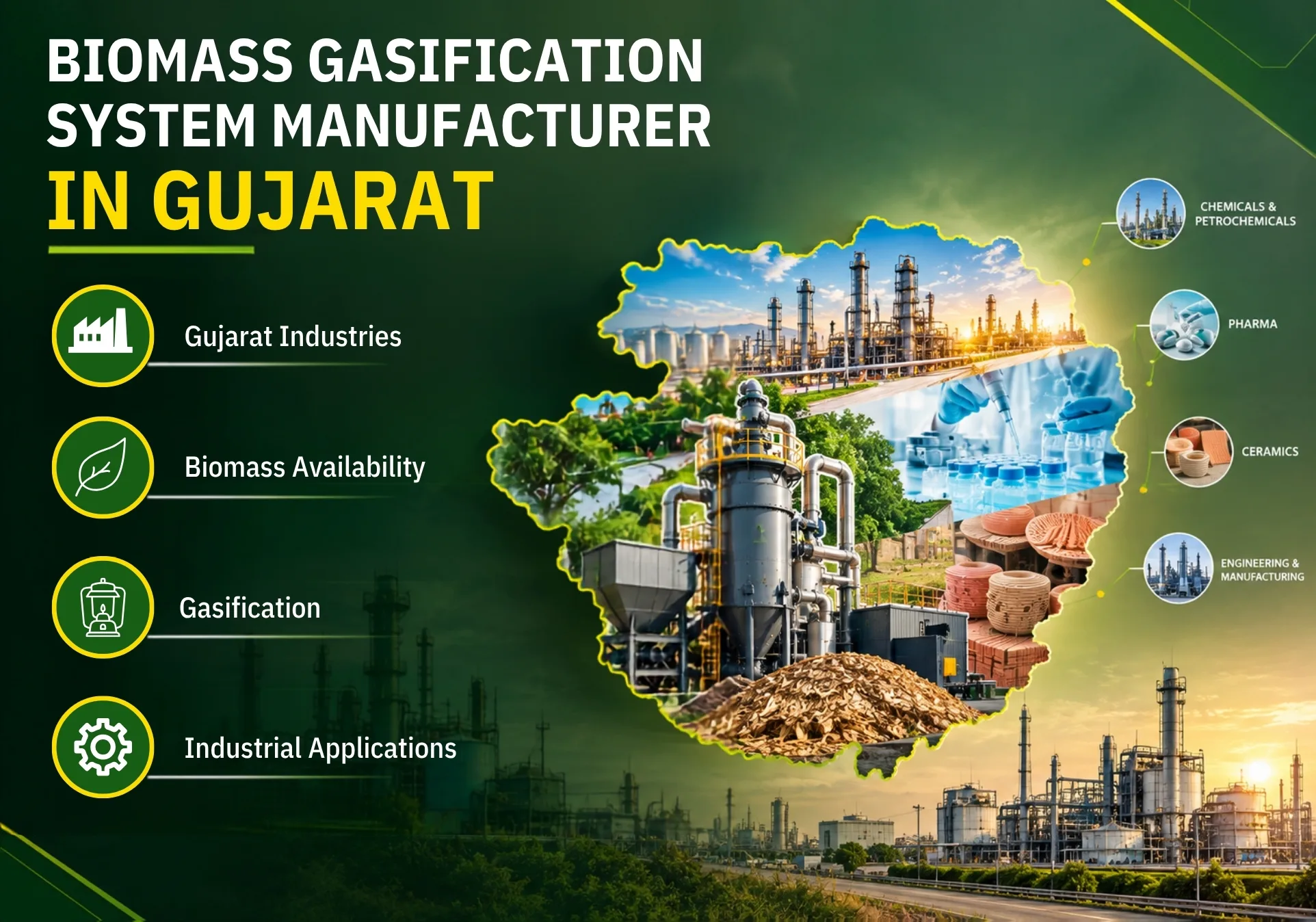
⚙️ Applications for Gujarat Industries
The right biomass gasification system depends on what the industrial plant needs to achieve. In Gujarat, suitable applications can include process heating, steam generation, and thermal applications where biomass can be technically integrated with the existing process.
🔥 Industrial Process Heat
Depending on the plant configuration, producer gas from biomass gasification can be used for industrial furnaces, dryers, kilns, process heating systems, and thermal processing equipment. For industries currently dependent on conventional fuels, biomass gasification can be evaluated as a fuel-replacement or fuel-reduction solution where technical conditions permit.
♨️ Industrial Boilers and Steam Generation
Biomass gasification can be integrated with industrial boilers for steam generation. Ankur Scientific's Madurai project demonstrates this: a biomass gasifier integrated with a 6 TPH Forbes Marshall boiler for industrial steam generation, replacing furnace oil. This type of application highlights why system integration matters — the gasifier must be considered together with the boiler and the plant's full thermal requirement.
🏭 Furnaces, Dryers and Kilns
Industries using continuous or batch thermal processes may evaluate biomass gasification as an alternative source of process heat — including furnaces, kilns, dryers, thermal treatment equipment, and other industrial heating systems.
🏙️ Why Gujarat Industries Are Evaluating Biomass Gasification
Gujarat has a large and diverse industrial base. Many industrial processes require continuous or high-temperature thermal energy. For suitable applications, biomass gasification can provide an opportunity to:
- Reduce dependence on conventional fuels
- Utilise suitable locally available biomass residues
- Generate producer gas for process heat
- Integrate renewable thermal energy into existing operations
- Explore biochar and carbon-related applications
Gujarat's process-heat requirements can vary significantly across sectors. Industries that may evaluate biomass gasification include:
The feasibility, economics, and system configuration will depend on the individual plant. A technical assessment is therefore an important first step before deciding whether biomass gasification is suitable.
🔬 Biomass Gasification Technology
Biomass gasification converts suitable solid biomass into combustible producer gas through a controlled thermochemical process. Inside the gasifier, the biomass passes through four stages:
- Drying — Moisture removed from the biomass feedstock
- Pyrolysis — Thermal breakdown of biomass under low-oxygen conditions
- Combustion — Partial oxidation generates process heat
- Reduction — Combustion gases are converted into combustible producer gas
The resulting producer gas can then be conditioned and supplied to the intended industrial application. The important consideration for any industrial project is that the biomass gasification technology needs to be matched with the feedstock, thermal requirement, and end-use equipment — not evaluated as a standalone piece of equipment.
🌾 Feedstocks Suitable for Gujarat Projects
Ankur Scientific has experience with more than 60 feedstock types. Depending on the application and system design, suitable biomass feedstocks can include:
However, feedstock selection should not be based only on local availability. Moisture, particle size, energy value, ash characteristics, consistency of supply, and handling requirements can all influence system performance. Ankur Scientific evaluates the available biomass as part of the technical assessment before determining the appropriate system configuration.
📍 Indian Project Reference Points
For Gujarat buyers, Ankur Scientific's Indian project experience provides a practical reference when evaluating biomass gasification for their own plants:
Madurai, Tamil Nadu
Biomass gasifier integrated with a 6 TPH Forbes Marshall boiler for industrial steam generation, replacing furnace oil.
Boiler Integration · Steam GenerationTamil Nadu Coast Belt — Six Plants
Biomass gasification systems deployed across six plants, including a customised producer-gas batch furnace for POP drying — demonstrating gasification for industrial thermal applications beyond power generation.
Industrial Thermal · Batch FurnaceNear Chennai
A 3,00,000 kcal/hr biomass gasifier deployed for a construction-material application with long-term operational performance.
Construction Materials · Long-Term OperationJalgaon, Maharashtra — 50 TPD PG2200
Multi-feedstock biomass gasification system using mango seeds, corncob, cotton stalk, bamboo, and wood chips — producing renewable syngas for steam generation alongside biochar production.
Multi-Feedstock · Biochar · Steam📋 What the Engineering Assessment Covers
Ankur Scientific approaches each Gujarat project based on the industrial application rather than supplying a standard system. The engineering assessment can consider:
- 1Current fuel and fuel consumption — Understanding the existing energy cost and supply situation
- 2Required thermal output — Matching the gasification system to actual process demand
- 3Existing boiler, furnace, dryer or kiln — Ensuring compatibility with current plant equipment
- 4Available biomass and its characteristics — Evaluating local feedstock options and suitability
- 5Biomass moisture and energy value — Key factors in system sizing and performance
- 6Operating hours and production requirements — Ensuring the system fits plant scheduling
- 7Required gasifier capacity — Sizing based on actual thermal demand, not a standard range
- 8Integration with the existing plant — Coordinating gas handling, burner retrofit, and safety systems
📐 System Capacity
Ankur Scientific's industrial biomass gasification systems can be configured across approximately 100 kg/hr to 2,500 kg/hr of biomass consumption, depending on the system and application. Capacity selection should be based on the required thermal output, existing fuel consumption, biomass characteristics, operating hours, application equipment, and plant operating conditions — not selected from a catalogue alone.
🏭 Engineering, Manufacturing and Project Support
Choosing a Biomass Gasification System Manufacturer in Gujarat is not only about selecting gasifier equipment. A successful industrial project requires engineering coordination between the gasifier, biomass handling system, gas conditioning, thermal application, and existing plant infrastructure. Ankur Scientific's capabilities include:
- In-house R&D and technology development
- System engineering and gasifier sizing
- Equipment manufacturing
- System integration with existing plant equipment
- Project execution and site installation
- Commissioning and performance verification
- Technical and after-sales support
Ankur Scientific's Vadodara base provides regional relevance for Gujarat industries — engineering coordination, site visits, and ongoing technical support are accessible without long lead times.
❓ Frequently Asked Questions
📩 Discuss Your Gujarat Industrial Requirement
If your Gujarat-based plant is evaluating biomass gasification for process heat, steam generation, fuel replacement, or another energy application — the right starting point is understanding your existing process and biomass availability. Let's evaluate it together.
Connect with Ankur Scientific.png)